Nordic Sprituality and the Importance of Nature
I recently came to think about Nordic sprituality after running across some interesting maps. They show very strikingly how we use the forest and spirituality as substitutes for organized religion. They can also explain to a very large extent why our country never really became Christian in the true sense, as some of our southern brothers did. Many people today see Sweden as a very atheistic society, full of people who don't really believe in anything. At least this is the image that many non-ethnic Swedes living in Sweden have of us, something that has probably rubbed off somewhat on our beliefs about ourselves. But what do we really believe in?
The importance of religion in everyday life
If you take a look at a map of Europe that shows the importance of religion to the citizens of the respective countries, you will find a rather disappointing picture of Swedes' spirituality. Only 10% of the population think that religion is an important part of their lives. Then you should also bear in mind that all residents of Sweden are included here, even those who have other religions than Christianity.
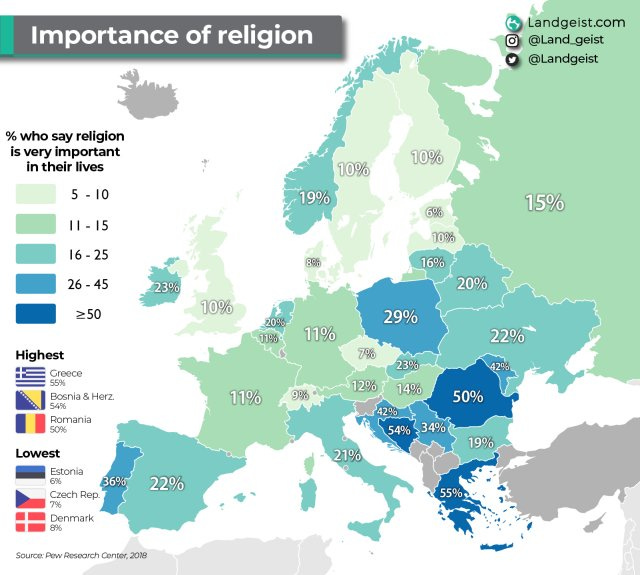
But this really says the most about whether we think religion is an important part of our lives, not how many people actually believe in a god. When we look at such a map, the percentage increases slightly, but not to any revolutionary levels right away.
Believe in a God
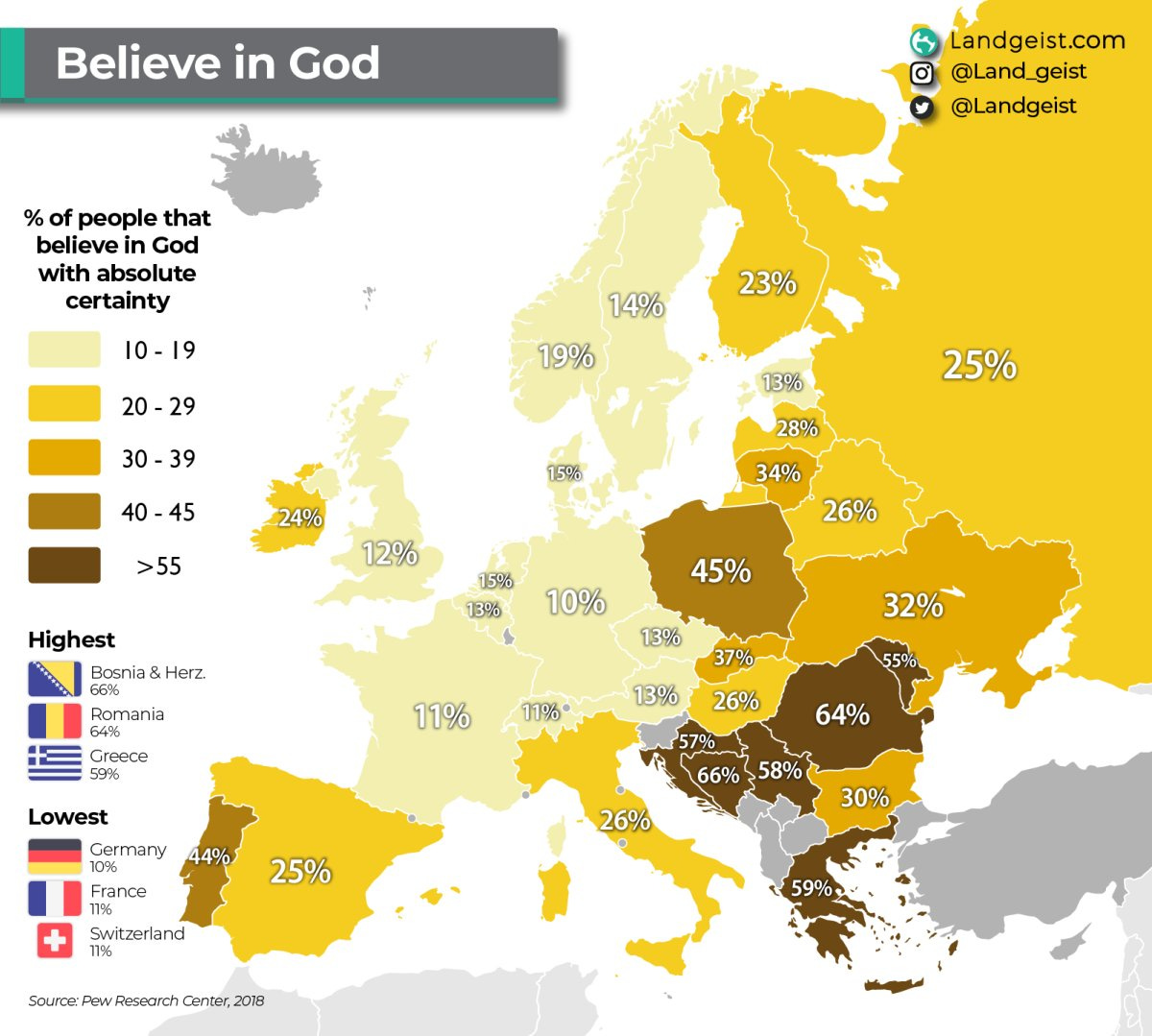 Proportion of population that definitely believes in a god in Europe.
Finland is quite interesting, only 10% think that religion is an important part of their life while more than twice as many are convinced that god exists. Another interesting detail is that the percentage of ethnic Swedes who think religion is important and who definitely believe in god is likely to be even lower than the 10% that the first map shows. Immigration to Sweden over the past 50 years has primarily been from countries that are significantly more religious than the Swedes.
Are we atheists?
What do Swedes believe in? Have we no Nordic sprituality? Are all atheists, as many non-Swedes I have discussed the issue with believe? It doesn't seem that way!
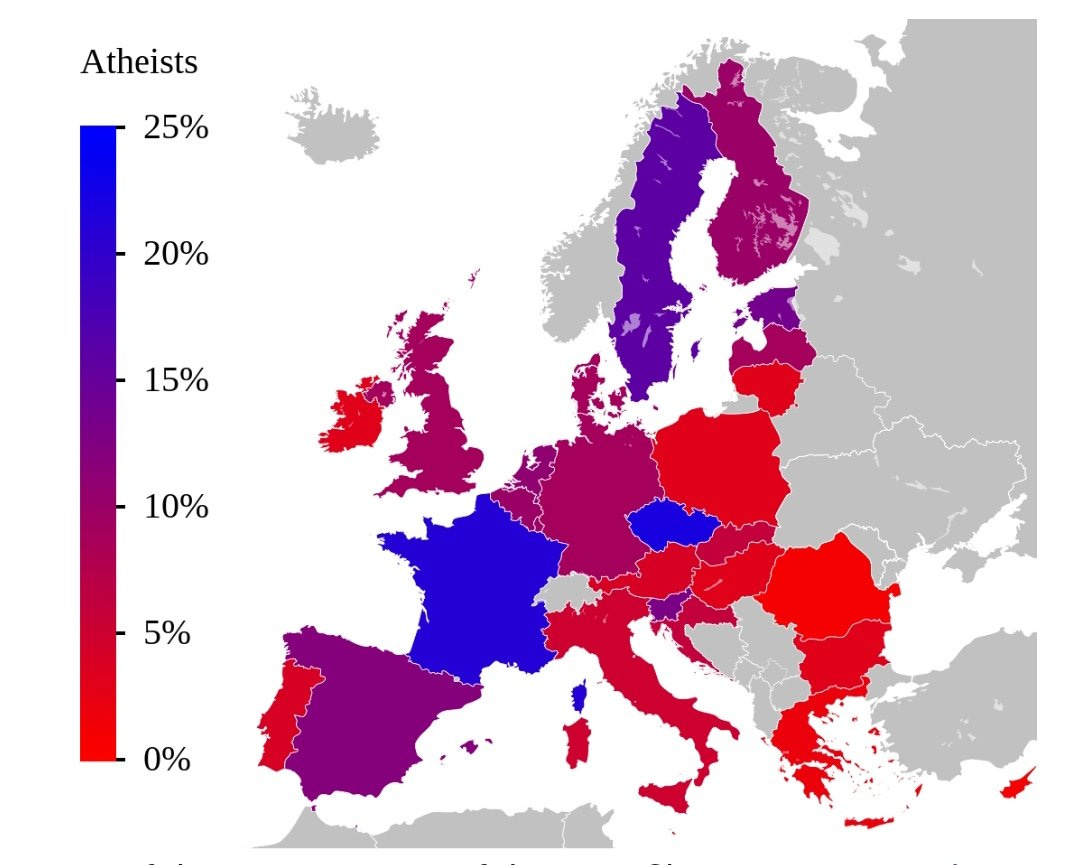 The proportion of atheists in European countries
The percentage of atheists in Sweden is higher than in many other countries, but is stable around 15%, which leaves quite a few Swedes lacking in spirituality.
If not atheists or religious, then what are we?
The big question then is: What does the Swede believe in then?
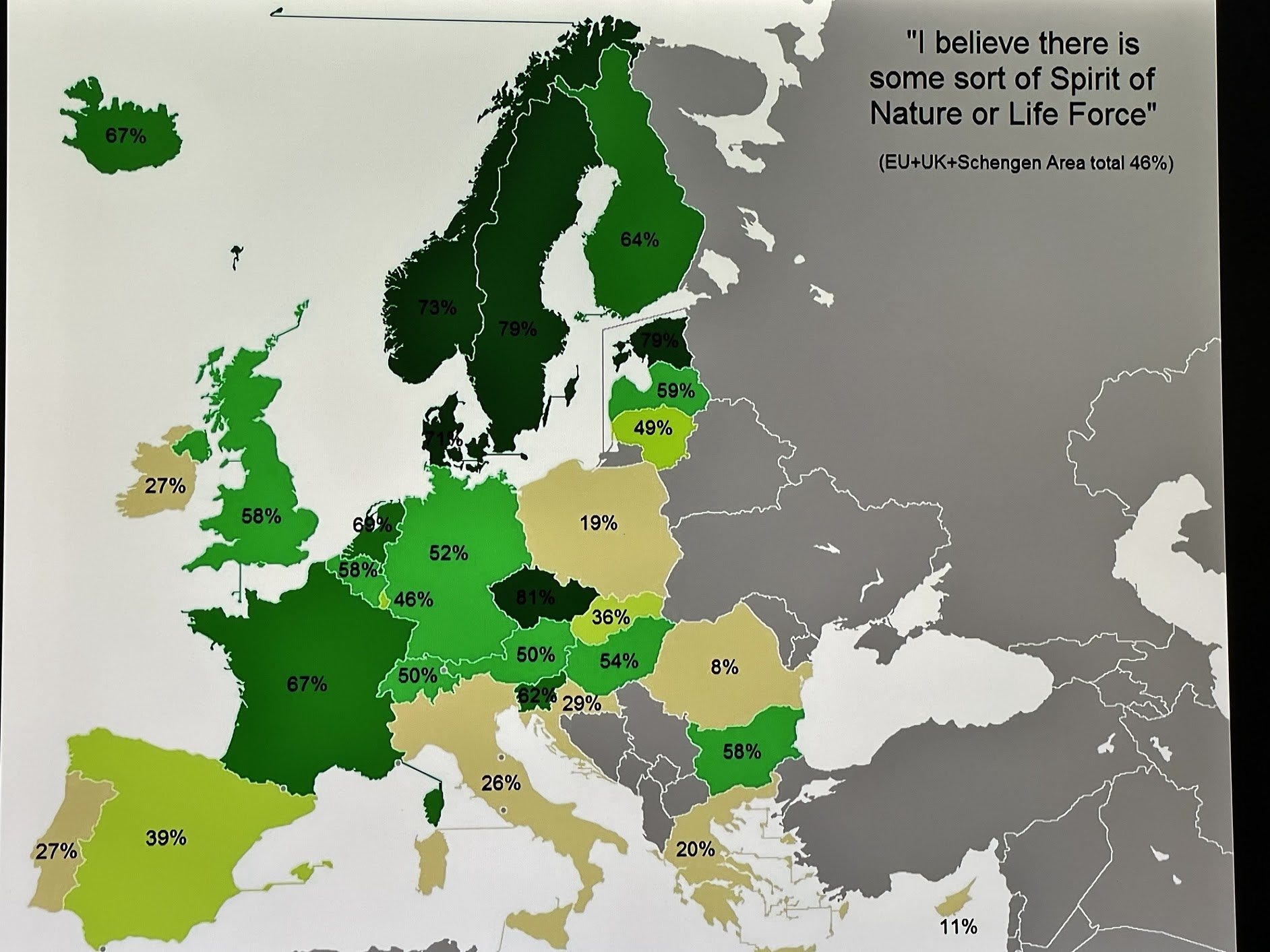 Proportion who believe "I believe there is some sort of Spirit of nature or life force" in European countries, forests and spirituality. Source: Twitter
This agrees very well with how many of the Swedes I have discussed the issue with look at the Nordic sprituality. You don't care much about state-sanctioned monotheistic religion, but you have your own ideas about what forces exist in nature and how best to practice your spirituality. Some of the first things many people learn when they are young is how to respect nature. It also means respecting all animals, big and small. This is something that hardly exists in all cultures. For some, the animals are lower standing as something that only produces food or the like.
The connection with outdoor life and spending time in nature in general is a very central part of many Swedes' lives. It can be seen in everything from hunting, hiking and mushroom picking, but also in how the laws are constructed around it.
The Forest and Nordic Sprituality
The forest is a place that has fascinated people for millennia. In many traditions, the forest is considered a place filled with mystery and magic, and there are many different beings believed to live there.
Nordic mythology
In the Old Norse mythological tradition, the forest was considered the home of giants, elves, dwarves and fairies, all with special powers and abilities. Many of the Norse gods and goddesses also made their home in the forest, including Frigg, Frej and Odin. Yggdrasil, the huge tree seen as the center of the universe, was also in the forest.
Essence, sacred places and self-realization
But it's not just gods and goddesses that haunt our minds even today. The forest was seen, and is still seen today, as the home of various different beings. Ceremonies and rites often took place in the forest at sacred places, stones and under special trees. Many also go into the solitude of the forest to pray, talk to ancestors and the departed. Others go there for spiritual enlightenment, and there were many different places in the forest that were believed to have special powers. Many people believed that one could get help and advice from nature by staying there. Some go so far as to say that one should not trust thoughts received indoors or in cities.
In both Norse mythology and folklore, the forest is regarded as a place filled with mystery and magic. There is a strong connection to nature and the beings that live there.
Never trust a thought that comes to you indoors
- Nietzsche
My own experience
I often find myself in a quiet part of the woods to get some peace of mind and clarity. There are occasions where this actually feels more like a spiritual thing that I have to do. I have thought a lot about why I need this and there are, of course, the more common explanations that we’ve evolved in- and with nature. I, however, believe there’s more to it than that! It's a feeling that's difficult to put into words, but I know I often leave the woods feeling like I’ve gained some sort of meaning and a direction in life.
I don't know if the maps are 100% accurate but they do illustrate how I perceive people to think about this! In any case, it is a very interesting topic whether different people groups are drawn more to monotheistic thoughts or to the worship of nature. What is your view on this? Do you find that people who have a great interest in nature and bushcraft activities are also drawn to a certain type of spirituality? Feel free to comment below!